

On this page
- What does a new gutter installation include?
- Why is drainage half the job in Everett?
- Which kinds of installation are there?
- How big should gutters be for Everett rain?
- Which parts make up a gutter system?
- How should gutters be fastened for Everett wind and snow?
- What does installation cost?
- Which houses around Everett need what?
- What should a written quote name?
- When is the best time to install?
What does a new gutter installation include?
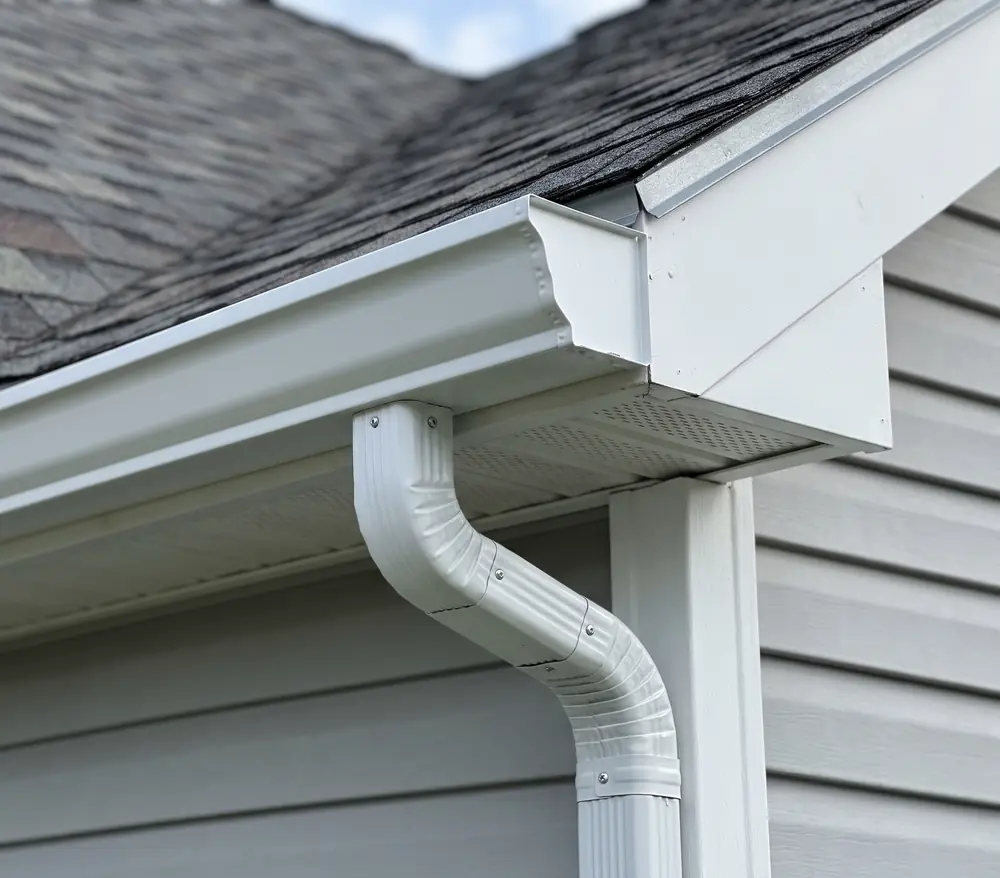
A full installation covers everything from the roof edge to the point where water leaves the property. On most Everett jobs the contractor will:
- Measure every eave and look at the roof, noting pitch, valleys, roofing type and anything that overhangs it.
- Take down the old system, including spikes, brackets and old straps, and check the fascia behind it for rot.
- Repair or replace the fascia where the wood has softened. In a climate this damp, a long-leaking gutter often leaves rot behind it.
- Fit or check the drip edge so water lands in the trough rather than tracking down the board.
- Form seamless runs on site to the exact length of each wall, in the agreed profile, metal, thickness and color.
- Hang the gutter on hidden hangers, usually about every 2 feet, with an even slope to each outlet.
- Cut outlets and fit downspouts, with elbows and straps fixed into framing rather than just siding.
- Finish the drainage with extensions, splash blocks or connections to tightlines so the water ends up away from the house.
- Seal corners and end caps, then run water through to show it flows and drains, and clear away the old metal.
Why is drainage half the job in Everett?
Much of the Everett plateau and the uplands around it sit on Vashon glacial till, which the U.S. Geological Survey describes as dense lodgment till commonly called hardpan, with water ponding on it and moving sideways across its surface. Roof water dumped at the foot of a wall on ground like that does not soak away; it creeps toward the foundation and into the crawl space. A good install finishes with extensions, splash blocks or tightlines that take water to ground falling away from the house, or to a dispersion area or drain the city allows.
North Everett adds another wrinkle. Much of the older north end runs on a combined sewer, where storm water and sewage share one pipe, and heavy storms there have backed water into basements. The city has worked with the Snohomish Conservation District on downspout disconnection in parts of the combined area, but any change to where a downspout connects should be checked with the city first.
Which kinds of installation are there?
| Type | Where it fits around Everett | Page |
|---|---|---|
| Seamless aluminum K-style | Most houses; the standard choice | Seamless gutters |
| 6-inch K-style | Two-story walls, steep roofs, valleys, heavy tree cover | 6-inch gutters |
| Aluminum in .032 inch | Under big firs, on tall walls, where wind and limbs hit hard | Aluminum gutters |
| Half-round | Craftsman and early-1900s houses, traditional new builds | Half-round gutters |
| Copper | Historic houses, brick and stone, long-life work | Copper gutters |
| Downspouts and drainage | Every house; the part most often skimped | Downspouts |
How big should gutters be for Everett rain?
The numbers are milder than people expect. Everett's 1991 to 2020 normals, tabled on Wikipedia, add up to 39.67 inches a year, with November the wettest month at 5.56 inches. What sets the area apart is persistence: measurable rain falls on about 170 days a year. So the test for a gutter here is less often a single violent hour and more often weeks of steady flow carrying needles, moss and grit toward the outlets. Atmospheric rivers do bring heavier spells; the series that hit in December 2025 helped make it one of the wettest months on record in Washington.
Contractors size from the roof rather than the floor plan:
- Roof area per run. The area of each plane that drains into a gutter, adjusted for pitch.
- Valleys. Two planes emptying into a few feet of gutter, which is why inside corners spill first.
- Outlets. More and larger downspouts often do more than a wider trough; a 3x4 carries about twice what a 2x3 does.
- Debris. Under firs and cedars, bigger outlets clog less often, and a guard may matter more than size.
| House | Typical choice |
|---|---|
| Plain single-story rambler | 5-inch K-style, with a downspout roughly every 30 to 40 feet |
| Single-story with valleys or a long porch roof | 5 or 6-inch, plus a 3x4 outlet at each inside corner |
| Two-story newer house | 6-inch K-style, 3x4 downspouts |
| Craftsman or early-1900s house | Half-round, often 6-inch, with round downspouts |
| Steep metal roof | 6-inch with closer hangers; metal sheds water quickly |
The 5-inch vs 6-inch guide goes through the decision in more depth.
Which parts make up a gutter system?
| Term | What it means on an Everett house |
|---|---|
| Drip edge | A bent metal strip along the roof edge that directs runoff into the trough so it cannot creep back along the fascia. |
| Gutter apron | Flashing slipped under the first row of shingles and lapped down into the gutter, used where shingles stop short of the trough. |
| Fascia | The board across the rafter ends that carries every hanger. Once it softens in the damp, no gutter stays straight on it. |
| Seamless gutter | A gutter formed on site from painted coil in one length per wall, so it is joined only at corners and end caps. |
| K-style gutter | The common profile with a flat back and an ogee front, which carries more water than a round trough of equal width. |
| Hidden hanger | A clip that grips the front lip and screws through the back of the gutter into the fascia, invisible from the street. |
| Miter | A corner joint, cut, riveted and sealed. Corners carry the most water and are usually the first joints to leak. |
| End cap | The closure at each end of a run, crimped, riveted and sealed. |
| Outlet | The opening cut in the gutter floor where a downspout attaches, normally with a riveted drop. |
| Downspout | The pipe that carries water from the gutter to the ground. Standard sizes are 2x3 and 3x4 inch; a 3x4 carries about twice as much. |
| A elbow | A downspout bend that turns front to back, bringing the pipe in toward the wall. |
| B elbow | A downspout bend that turns left or right, used to step around windows and corners. |
| Splash block | A concrete or plastic pad below the outlet that fans the water out and keeps it from digging a pit. |
| Tightline | Solid pipe that carries downspout water underground to a dispersion trench, ditch or approved drain, the usual term in western Washington. |
How should gutters be fastened for Everett wind and snow?
Everett's worst wind comes in winter storms. The Hanukkah Eve windstorm of December 2006 brought gusts of up to 66 mph to Snohomish County and left as many as 120,000 people there without power, and the November 2024 bomb cyclone put trees onto houses from Everett to Lake Stevens. Lowland snow is uncommon but heavy and wet when it comes; in February 2019 the weather service logged 7 inches in Everett and Lake Stevens.
| Detail | Common spec | Why it matters here |
|---|---|---|
| Hangers | Hidden screw hangers about 24 inches apart | Spikes back out of wet wood; screws hold through wind and snow load |
| Screws | Long enough to reach solid wood or rafter tails | Grip is only as good as the wood behind it |
| Metal | .032 aluminum on exposed walls and under big trees | Thicker coil resists dents from limbs, cones and ladders |
| Downspout straps | Into framing, at least top and bottom | Stops downspouts swinging loose in a gale |
| Corners | Riveted and sealed miters, sometimes reinforced | Heaviest flow and most movement |
| Ends | Crimped, riveted and sealed caps | Stops drips that run down the wall |
What does installation cost?
Gutters are quoted per installed foot. National guides from Angi and This Old House put seamless aluminum at roughly $9 to $13 a foot for 5-inch and $12 to $18 for 6-inch, with steel lower and copper well above. A local quote also depends on wall height, the number of corners and downspouts, tightline work, fascia repair, guards and removal of the old system.
| Item | What it adds |
|---|---|
| Second story or steep site | Extra ladder and staging time |
| Each inside or outside corner | A mitered joint to cut, rivet and seal |
| Each extra downspout | Outlet, elbows, straps and pipe |
| Tightline or extension work | Pipe, digging and connections |
| Fascia replacement | Carpentry before the gutter goes up |
| Guards | Priced per foot on top of the gutter |
| Removal and disposal | Taking down and hauling away the old system |
The cost guide and the estimator on the home page go into more detail.
Which houses around Everett need what?
| House | Typical install |
|---|---|
| Craftsman or Foursquare in North Everett or Riverside | Half-round or K-style on repaired fascia; check overlay rules first |
| Early-1900s house on Rucker Hill | Half-round or copper with round downspouts |
| Mid-century rambler in View Ridge-Madison | 5-inch seamless, careful drainage near the bluff |
| 1970s to 1990s house around Silver Lake | 5 or 6-inch seamless, guards under conifers |
| Newer two-story in Marysville or Lake Stevens | 6-inch K-style, 3x4 downspouts, tightlines |
| River-town house in Snohomish or Stanwood | Period profile, drainage away from low ground |
| Wooded lot near Granite Falls or Arlington | Heavier metal and micro-mesh under tall timber |
What should a written quote name?
- Gutter profile and size (5-inch or 6-inch K-style, or half-round).
- Metal and thickness, such as .032 aluminum or 16-ounce copper.
- Color, for gutters and downspouts.
- Hanger type and spacing.
- Number, size and position of downspouts, and where each one empties.
- Any fascia or drip-edge work, and how it is priced.
- Guards, if included, by product and type.
- Removal and disposal of the old gutters.
- Any warranty on workmanship from the contractor, and on finish from the maker.
When is the best time to install?
Late spring through early fall, when roofs and fascia are dry and contractors can schedule without dodging weather. Gutters installed by September are ready for the first fall storms and the needle drop that comes with them. If your gutters are failing in mid-winter, a contractor can still work between fronts, and patching a run through to summer is often an option.